Roofing FAQs: Owasso, OK
Straight answers to the questions Owasso homeowners actually ask — costs, insurance, hail, wind, repair versus replacement, and what to do right now. No jargon, no sales pitch.
These are the questions we hear most from Owasso homeowners — about what repairs cost, what insurance actually covers, how hail damage works, and when a roof is done. Every answer is written for Oklahoma specifically, because roofing advice from a mild climate doesn't apply here. For the deep dives behind these answers, see our roof repair cost guide and our Oklahoma roof insurance claims guide — or skip straight to a free inspection and get answers about your specific roof.
Cost Questions
Researched market estimates: $100–$700 for minor shingle repairs, $200–$1,500 for leak repairs, $150–$600 for flashing repairs, $300–$2,500 for partial re-decking or structural work, and $175–$700 for emergency tarping (after-hours tarping runs $1.00–$2.80 per square foot). Tulsa-area data corroborates the picture, with average repairs between $390 and $3,600. These are market estimates, not a price list — a free inspection gives you an exact, itemized number for your roof. For the full breakdown, see our roof repair cost guide.
Because scope is a judgment call, and judgments differ. One roofer's $400 flashing repair is another's $1,200 "replace the whole valley" — and both might be looking at the same roof. The variables that legitimately move a quote: the failed component, the repair area, roof steepness and accessibility, shingle matching difficulty, and what the repair uncovers (rotted decking turns a small job into a bigger one). The defense against quote roulette is an itemized scope: materials, labor, and square footage in writing, with a fixed number before work starts. That's what our inspections produce — and it's what you should demand from any roofer.
Repair is almost always cheaper per job — the question is how many repairs the roof needs. A single $500 flashing repair on a roof with ten good years left is obviously the right call. But a roof needing its third $800 repair in two years, with widespread granule loss and brittle shingles, is telling you the economics have flipped. The honest way to decide: an inspection that photographs the roof's overall condition, not just the current leak. Repair the localized failures; replace when failures are systemic. And get a second opinion before any replacement — a free inspection is exactly that.
Insurance Questions
Often, yes — when the hail caused functional damage: bruised or fractured shingle mats that break the roof's waterproofing or shorten its remaining life. Purely cosmetic damage (dents that don't affect function) is increasingly excluded by Oklahoma policies. Two more things decide your outcome: whether your policy pays replacement cost or actual cash value on the roof (ACV depreciates, so older roofs pay out less), and your wind/hail deductible, which is commonly 1–5% of the home's insured value — separate from your standard deductible. Check your policy or talk to your agent. Our full walkthrough is on the Oklahoma roof insurance claims page.
Oklahoma law (HB 3495) sets a floor: any policy that specifies a time limit for wind or hail roof damage must allow filing up to 24 months after the date of loss, when the damage isn't evident without inspection — which describes hail bruising exactly, since it can hide for months before leaking. But the Oklahoma Insurance Department's standing advice is to file as soon as possible after the storm, and sooner is always stronger evidence. Don't sit on suspected damage waiting out the clock; document it now.
Functional damage breaks the roof's ability to do its job — fractured shingle mats, broken waterproofing, shortened service life. Cosmetic damage only changes appearance — dents that don't impair function. Oklahoma insurers pay for functional damage and increasingly exclude cosmetic damage through policy endorsements; one Oklahoma court case defined cosmetic as damage that "only alters the physical appearance" without allowing water penetration or functional failure. The line between the two is decided by documentation: close-up photos of the failure points, the storm date on record, and a clear statement of what failed and why. That's what our inspection reports are built to provide.
We can't answer that for your policy — it's between you, your agent, and your carrier's practices. What we can say: Oklahoma is a high-risk hail state, carriers price that risk into the market, and a documented, legitimate storm claim is what the coverage exists for. The factors that matter more than the filing itself are your claims history, your carrier's surcharge practices, and whether the damage is functional (covered) versus cosmetic (increasingly excluded). Talk to your agent before you file if you're weighing it — and get the damage documented regardless, so the option stays open.
Hail & Wind Questions
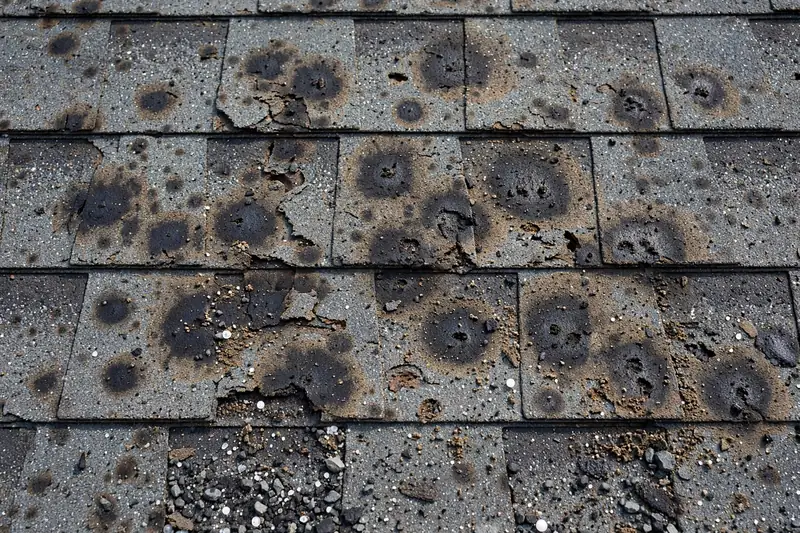
From the ground, you usually can't — that's the central trap of hail damage. A bruised shingle mat hides under granules that look intact; the fracture underneath doesn't leak for months. The reliable signs an inspector looks for: bruising concentrated on windward slopes (felt by hand as soft spots), granule loss in impact patterns, fractured mats visible at close range, and collateral damage — dented vents, gutters, and downspouts hit by the same storm. If golf-ball-size hail or larger hit your neighborhood, schedule an inspection even with no visible damage and no leak. The May 8, 2026 storm dropped 2.00-inch hen-egg hail within five miles of Owasso; damage from that event is still surfacing.
Four steps, in order: (1) Stay safe — don't climb on the roof yourself, especially with potential structural damage or power lines down. (2) Document from the ground — photograph any visible damage, note the storm date and hail size if you saw it. (3) Schedule a professional inspection — the inspector documents what you can't see from the ground and ties it to the storm date. (4) Call your insurance agent — file as soon as possible; the state insurance department advises against waiting. If water is coming in, emergency tarping ($175–$700 market estimate) protects the interior while the claim proceeds.
Absolutely — straight-line winds are Owasso's other roof killer. Wind breaks shingle seal strips and lifts tabs; once a tab is lifted, the next gust tears it off or creases it, and a creased shingle is a future leak at the bend line. Ridge caps are the first thing to go. After any high-wind event, walk the yard: shingles on the ground mean shingles missing from the roof, and that's an inspection trigger even if nothing is leaking yet. Wind damage follows gust paths, so it often concentrates on ridges, hips, and windward eaves while the rest of the roof looks untouched.
For most homeowners re-roofing in hail country, yes. Class 4 shingles are tested to UL 2218 and survive hail impacts that fracture standard shingle mats — and several Oklahoma carriers discount the wind/hail portion of your premium for a verified Class 4 roof, commonly 15–30% of that portion, with Mercury's 2026 Oklahoma product averaging $420 a year. The discount applies to the wind/hail portion, not the whole bill, and carriers typically require a UL 2218 Class 4 certificate — ask your agent. If your current roof has years of life left, the question waits; if you're re-roofing, Class 4 deserves a hard look.
Roofing Materials Questions
Material choice matters more in Oklahoma than in milder climates — hail, straight-line wind, and 100°F-plus summers punish the wrong pick. If you're repairing, the question is usually whether new shingles can match what's already on the roof; if you're re-roofing, it's which material earns its keep against hail season.
- Architectural shingles — the standard for Oklahoma homes
- Class 4 impact-resistant shingles — the hail-country upgrade
- Standing-seam metal — the decades-long investment
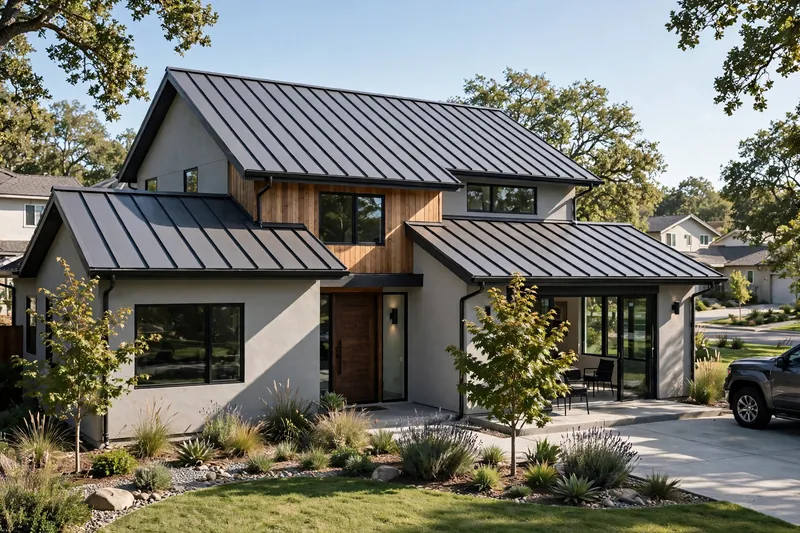
Class 4 impact-resistant shingles — they're tested to UL 2218 to survive hail impacts that fracture standard shingle mats, and several Oklahoma carriers discount the wind/hail portion of your premium for a verified Class 4 roof (commonly 15–30% of that portion). Standing-seam metal is the other proven answer: metal doesn't bruise or crack the way asphalt does. Standard architectural shingles still handle Oklahoma weather well for their price — they're the right call for most repairs — but if you're re-roofing in hail country, Class 4 deserves a hard look. Details on our asphalt shingle roofing and metal roofing pages.
Usually, yes — we match shingle color and profile to the existing roof wherever the product is still manufactured. Architectural shingles come in standardized color families, so a close match is the normal outcome. The exception is discontinued lines and colors: shingles from a line the manufacturer killed years ago can't be matched new, and we'll tell you upfront when that's the case — options then include the closest current match or concentrating the repair on a less visible slope. New shingles also won't perfectly match fifteen years of UV fade at first, but they weather in over time.
For most Oklahoma homes, no — architectural shingles have become the default for good reason. 3-tab shingles are single-layer and thinner: they cost less upfront but they're more vulnerable to exactly what Oklahoma does to roofs — wind creasing and blow-off, faster granule loss, shorter service life. Architectural (dimensional) shingles cost modestly more and carry heavier mats, better wind ratings, and longer warranties — real advantages in hail and wind country. We still repair 3-tab roofs all the time (most of Tulsa's older housing stock wears them), but for a re-roof, architectural is the honest recommendation.
It can be — if you're thinking in decades. Standing-seam metal costs substantially more upfront than shingles, but it shrugs off hail that would total an asphalt roof, handles straight-line wind far better, and manufacturers typically rate it at 40–70 years of service life. Some Oklahoma carriers also discount premiums for metal roofs. The trade-offs are real: higher upfront cost, and it needs a crew that knows metal detailing — valleys, penetrations, and expansion joints done wrong are expensive to fix. For a forever home in hail country, the math often works; for a home you might sell in five years, shingles usually win. Our shingle vs. metal comparison lays out the full trade-off.
Synthetic underlayment is the modern standard — lighter, stronger, and more UV-tolerant than old felt paper if the roof sits exposed for a few days mid-job. In the places water concentrates — valleys, eaves, around chimneys and penetrations — a self-sealing ice-and-water membrane adds a second line of defense that matters in Oklahoma's driving-rain storms. You rarely see underlayment, but it's the layer that keeps a minor shingle failure from becoming interior damage. Any reputable re-roof in Oklahoma should specify synthetic underlayment plus membrane in the valleys — if a quote doesn't say which, ask.
Oklahoma weather shortens roof life compared to milder climates — hail and wind are the reason. As a rule of thumb: architectural shingles last 20–30 years here, 3-tab shingles 15–20, standing-seam metal 40–70, and flat/low-slope membranes 15–25 depending on the system and maintenance. But those are averages — a shingle roof that takes two major hail events in five years may be functionally done long before year twenty, while a well-maintained roof in a sheltered spot can outlast the averages. Age alone doesn't decide repair vs. replace; condition does. A free inspection tells you where your specific roof stands, whatever the calendar says.
Repair, Tarping & Inspection Questions
Most repairs finish in a single day. Minor shingle or boot repairs often take one to three hours; leak repairs and flashing work typically run half a day; partial re-decking can take a full day. Emergency tarping happens the same day you call. Scheduling usually runs one to five business days out — longer right after a major storm, when every roofer in the metro is booked. The free inspection itself takes about 45 minutes to an hour.
Tarping is the stop-the-bleeding step: a heavy-duty waterproof tarp secured over the damaged area to keep water out until permanent repairs happen. You need it when the roof is open to the sky — missing shingle courses after a wind event, a tree limb through the decking, hail damage that's actively leaking — and rain is coming or already here. Market estimates run $175–$700 for typical tarping, with after-hours emergency work at $1.00–$2.80 per square foot. It's temporary protection, not a repair; the permanent fix still needs scheduling. Most insurers expect you to mitigate further damage, so tarping promptly also protects your claim.
Once a year at minimum, timed for late winter or early spring — before Oklahoma's April–May hail peak. Twice yearly (adding a fall visit for debris and drainage) suits older roofs and homes under heavy tree cover. And always after a major storm: hail and high winds are the two events that create damage you can't see from the ground. Our inspections are free, on the roof and in the attic, with photos you keep — so the cost of checking is zero and the cost of not checking is the leak you find six months later.
Get a free inspection from a company with no stake in the answer — that's us, or any reputable local roofer willing to put findings in writing with photos. The second opinion should answer three questions with evidence: what's actually failing (photographed), whether the failures are localized or systemic, and what repair would cost versus replacement. Be wary of any "replacement" recommendation that can't show you widespread failure on camera. Replacement is the right call when failures are systemic — multiple leak sources, granule loss across entire slopes, brittle shingles, soft decking in multiple zones. If the evidence shows one failed flashing detail, that's a repair, not a roof.
Still Have Questions? Get Answers About Your Roof.
Every roof is different, and generic answers only go so far. A free inspection — on the roof and in the attic, with photos you keep — answers every question above for your specific house. Contact Owasso Roofing Pros, or dig deeper into costs and insurance claims first.