Shingle vs. Metal Roofs in Oklahoma: The Hail-Country Guide
The honest head-to-head for Owasso homeowners: what each roof costs, how each handles hail, what each does to your insurance — and which one actually fits your house, your budget, and your timeline.
Free inspectionNo-pressurePhotos of everything
Shingle vs. metal is the biggest roofing decision an Owasso homeowner makes — and in Oklahoma, the answer isn't the same as it is in a mild climate. Hail is the deciding factor here: golf-ball and hen-egg hail both fell within miles of Owasso in 2026, and the material you choose determines whether the next storm is a non-event, a repair bill, or an insurance claim. Owasso Roofing Pros works with both materials every week. This guide lays out the honest tradeoffs — cost, hail performance, insurance, noise, and resale — so you can make the call with real information instead of sales pressure. For the deep dives, see our asphalt shingle roofing in Owasso page and our metal roofing in Owasso page.
One framing note before the table: most Owasso homes are shingle-roofed, and that's fine. Metal is a premium upgrade, not a requirement. The question is never "which is better" — it's "which is better for your house, your budget, and how long you're staying."
The Head-to-Head: Shingles vs. Metal in Oklahoma
| Factor | Architectural asphalt shingles | Metal roofing (standing seam) |
|---|---|---|
| Upfront cost | The price baseline for Owasso re-roofs. Tulsa-area full roof replacements typically range $5,000–$18,800 (market estimates); shingles sit at the lower end of that range. | Higher upfront — premium materials plus specialized installation labor, substantially above the installed cost of architectural shingles on a typical home. Exact numbers come from the free inspection quote, not a table. |
| Service life in Oklahoma | Designed to serve for decades, but hail, wind lift, and UV shorten actual life versus mild climates. Most shingle roofs in Owasso face at least one major hail event in their lifetime. | Longer inherent service life than shingles — metal doesn't crack from UV or lose granules. Hail dents it rather than fracturing it, and panels are individually replaceable. Still ages: fasteners, sealant, and coatings need attention over the decades. |
| Hail performance | Standard shingles bruise and fracture under large hail — the hidden mat damage that breaks waterproofing. Class 4 impact-resistant shingles (UL 2218) dramatically improve hail resistance at a moderate upcharge over standard architectural. | Excellent against fracture — hail dents the panel surface but rarely breaks through. Severe hail can cosmetically dent softer metals; heavier-gauge standing seam resists denting better than thin screw-down panels. |
| Insurance impact | Standard shingles: no discount. Verified Class 4 impact-resistant shingles: carriers discount the wind/hail portion of the premium — commonly 15–30% of that portion, with Mercury's 2026 Oklahoma product averaging $420/yr. | Impact-rated metal roofs (Class 4 / UL 2218 rated products) can qualify for the same wind/hail premium discounts — ask your agent what documentation your carrier requires. Non-rated metal may not qualify. |
| Noise | Quiet in rain and hail — the asphalt and granule mass absorbs impact sound. | Louder in heavy rain and hail without proper underlayment and attic insulation. With solid decking, quality underlayment, and insulation, interior noise is comparable to shingles — but the installation details matter. |
| Repairs | Straightforward and inexpensive: minor shingle repairs run $100–$700 (Angi 2026 market data), and any roofer can do them. A square of shingles is 100 sq ft — typically 3 bundles — so small repairs are a materials run, not a special order. | Repairs need a metal-experienced crew: panel replacement, fastener re-sealing, and coating touch-ups. Fewer contractors do it well, and matching aged panels is harder than matching shingles. |
| Resale | The Owasso default — buyers expect architectural shingles, and a new architectural roof is a solid selling point without pricing you out of the neighborhood. | A differentiator in the Owasso market: standing-seam metal reads as premium and can help a listing stand out. Recoup depends on the neighborhood — in mid-range subdivisions, you won't recover the full upcharge at sale. |
Typical ranges based on national industry data — every roof is different. Your free inspection gives you the exact number, itemized. These are market estimates, not our price list.
How Do Shingles and Metal Each Handle Oklahoma Weather?
Hail is the deciding factor: standard shingles take hidden mat fractures that break waterproofing, Class 4 shingles close most of that gap, and metal takes dents while keeping shedding water. Both handle wind when installed correctly — shingles at 110–130 mph sealed ratings, metal through interlocking concealed-fastener panels.
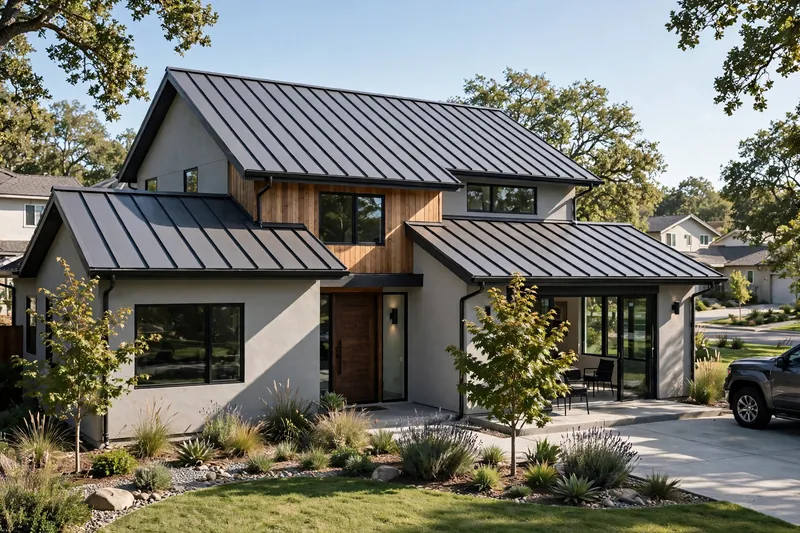
Standing-seam metal: interlocking panels with concealed fasteners — the premium option for hail country.
Hail: The Deciding Factor
Hail is where the two materials genuinely differ. A standard architectural shingle takes large hail as mat fractures hidden under granule loss — damage you can't see from the ground that breaks the waterproofing within a few storm cycles. Class 4 shingles close most of that gap at a moderate upcharge. Metal takes hail as dents: the panel surface deforms but the roof keeps shedding water. That's the core tradeoff — shingles (even good ones) can be functionally killed by hail; metal gets cosmetically marked but keeps working.
The insurance angle follows the same logic. Insurers pay for functional damage — damage that breaks waterproofing or shortens roof life — and increasingly exclude purely cosmetic damage. A dented-but-functional metal roof may not trigger a claim the way a fractured shingle roof does. That's a feature, not a bug: fewer claims, lower long-term cost of ownership.
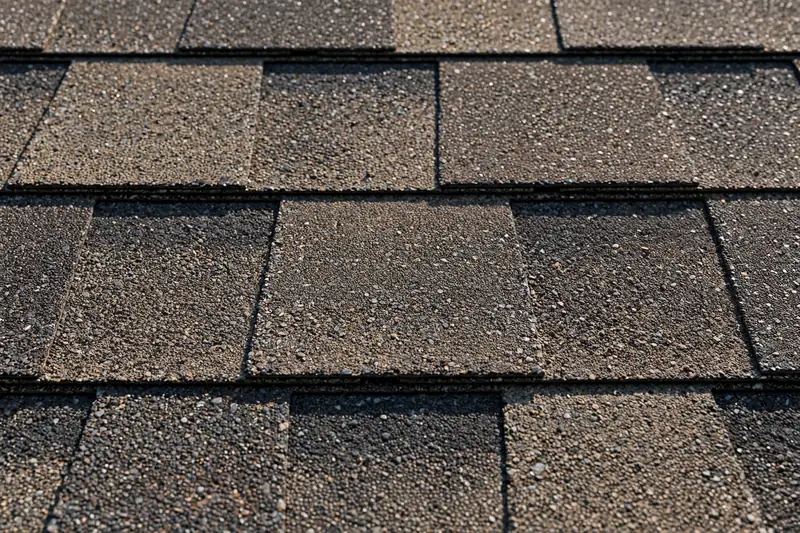
Architectural shingles: the Owasso default — two laminated layers, and available in Class 4 hail-rated versions.
Wind and Heat
Both materials handle Oklahoma wind when installed correctly — architectural shingles are rated for 110–130 mph winds when sealed, and standing-seam metal's interlocking panels with concealed fasteners are among the most wind-resistant residential systems made. The failure mode for shingles is seal-strip blow-off and creased tabs; for metal, it's fastener back-out on cheaper screw-down systems and flashing details at penetrations. Summer heat is kinder to metal (it reflects more and doesn't rely on sealant strips), though both need proper attic ventilation to age well.
Fire and Longevity
Metal doesn't burn, which matters in wildfire-adjacent areas and for homeowners who simply want the most durable envelope. Shingles are Class A fire-rated as a system but remain a petroleum product that ages. Over a long ownership horizon — 20+ years — metal's maintenance profile is lighter: no granule loss, no seal-strip re-bonding, no boot-driven leak cycles. Shingles ask for more attention (annual inspections, periodic boot and flashing work) but that attention is cheap: minor shingle repairs run $100–$700.
Shingle or Metal: Which Roof Fits Your Situation?
Forget "better" — match the material to the house. Budget-first or selling within 5–10 years: architectural shingles. Re-roofing in hail country and want the discount: Class 4 shingles. Long-term home, multiple past hail claims, budget for premium: metal. The breakdown below:
Choose architectural shingles if…
- Budget is the primary constraint — shingles are the lowest upfront cost and the Owasso standard.
- You're selling within 5–10 years — a new architectural roof sells the house without over-improving for the neighborhood.
- Your roof has years of life left — repair it; the material debate can wait.
- You want the cheapest maintenance path — shingle repairs are $100–$700 and every roofer does them.
Step up to Class 4 shingles if…
- You're re-roofing anyway — the Class 4 upcharge over standard architectural is moderate, and the hail resistance plus the insurance discount (commonly 15–30% of the wind/hail premium portion, averaging $420/yr on Mercury's 2026 Oklahoma product) changes the math.
- You want shingle pricing with near-metal hail performance — Class 4 is the sweet spot for most Owasso homeowners.
Choose metal if…
- This is your long-term home — 15+ years — where metal's durability and low maintenance compound.
- You've been through multiple hail claims and want a roof that takes the next storm as dents, not fractures.
- The premium look matters — standing seam is a genuine curb-appeal upgrade in Owasso's market.
- Your budget absorbs two to three times the shingle cost without strain — metal should never be a stretch purchase.
Our honest take for most Owasso homeowners re-roofing today: Class 4 architectural shingles. You get hail-rated impact resistance, the insurance discount, shingle-level repair costs, and you stay in budget. Metal is the right call for long-horizon owners who want the last roof they'll buy. Either way, the free inspection gives you the real numbers for your house — not a generic recommendation.
Shingle vs. Metal FAQs
Substantially more — premium materials plus specialized installation labor put metal well above shingle pricing. Tulsa-area full roof replacements typically range $5,000–$18,800 (market estimates), with shingles at the lower end and metal at the upper end of that range. These are market estimates, not a price list — the free inspection quotes your specific roof with an exact, itemized number.
Against functional failure, yes. Hail dents metal panels but rarely breaks through them — the roof keeps shedding water. Standard shingles can take hidden mat fractures from the same storm that break waterproofing over the following months. Class 4 impact-resistant shingles (UL 2218) close most of that gap at a moderate upcharge, which is why they're the sweet spot for many Owasso homeowners.
It can — impact-rated metal roofs (Class 4 / UL 2218 rated products) can qualify for the same wind/hail premium discounts that Class 4 shingles get: commonly 15–30% of the wind/hail portion of the premium, with Mercury's 2026 Oklahoma product averaging $420/yr. Non-rated metal may not qualify, and the discount applies to the wind/hail portion, not the whole bill. Ask your agent what documentation your carrier requires.
It can be without proper installation — bare metal over open framing is noticeably louder than shingles in heavy rain and hail. With solid decking, quality underlayment, and attic insulation, interior noise is comparable to a shingle roof. The installation details matter here, which is one reason to use a crew that does metal regularly rather than a shingle crew trying it once.
Sometimes — metal can be installed over one layer of shingles with proper furring and underlayment, which saves tear-off cost. But the existing roof's condition decides: damaged decking, multiple shingle layers, or ventilation problems all argue for a full tear-off. The inspection determines which path your roof qualifies for, and we'll tell you honestly which is right rather than defaulting to the cheaper option.
Then repair it — the material debate only matters at replacement time. Minor shingle repairs run $100–$700 (Angi 2026 market data), and a shingle roof with years of life left deserves repair, not replacement. See our asphalt shingle page for repair details or our metal roofing page when replacement enters the conversation.
Get the Real Numbers for Your Roof
Shingle, Class 4, or metal — the right answer depends on your roof, your budget, and your timeline. A free inspection gives you the exact numbers for all three, with photos and zero pressure. Start with our shingle page or metal page, then call.
Free inspection · No-pressure · Photos of everything