Oklahoma Roof Insurance Claims: A Step-by-Step Guide
How roof insurance claims actually work in Oklahoma — what's covered, the 24-month filing window, the adjuster process, cosmetic vs. functional damage, and what to do if your claim is denied. Plain language, sourced facts, zero legal advice.
Free inspectionNo-pressurePhotos of everything
An Oklahoma roof insurance claim is a process with rules, deadlines, and definitions — and the homeowners who get fair outcomes are the ones who understand them before the adjuster arrives. Owasso Roofing Pros documents storm damage the way adjusters need it documented — but this page is the map, not the legal advice. We are not a law firm and this is not legal or financial advice: check your policy and talk to your agent for anything that affects your coverage. Every fact below is sourced; where a law's status is uncertain, we say so instead of smoothing it over.
The short version: Oklahoma law gives you up to 24 months after a wind or hail loss to file when the damage isn't visible without inspection. Insurers pay for functional damage — damage that breaks waterproofing or shortens roof life — not purely cosmetic damage. Your deductible for wind/hail is commonly 1–5% of your home's insured value, separate from your standard deductible. And the difference between "cosmetic" and "functional" is decided by documentation: dated photos, an inspection report, and the storm date on record.
Will My Homeowner's Insurance Cover Hail or Wind Damage?
The direct answer: wind and hail damage to your roof is typically a covered peril under Oklahoma homeowner's policies — but coverage is shaped by three things: functional versus cosmetic damage, replacement-cost versus actual-cash-value terms, and your wind/hail deductible (commonly 1–5% of insured value).
In more detail: "functional" means damage that breaks waterproofing or shortens roof life, versus purely "cosmetic" damage that alters appearance only; your wind/hail deductible is often separate from your all-other-perils deductible; and the Oklahoma Insurance Department's consumer guidance says to check with your provider about higher hail deductibles and cosmetic-damage exceptions before you assume what's covered.
The ACV-vs-replacement-cost distinction is the one that surprises homeowners most. Under replacement cost, the insurer pays what it costs to replace the damaged roof (minus deductible). Under actual cash value, the roof depreciates — a 15-year-old roof pays out far less than a 5-year-old one for identical damage, because the insurer subtracts the "used up" life. Illustratively: a 15-year-old roof halfway through a 30-year shingle life could see roughly half the replacement cost depreciated away before the deductible is even subtracted. Oklahoma policies have been shifting toward ACV on roofs, so this is not a detail to discover after the adjuster leaves: read your declarations page or ask your agent which basis your roof carries.
| Term | What it means for your roof claim |
|---|---|
| Covered peril (wind/hail) | The event that damaged your roof — typically covered, but check named exclusions on your policy |
| Functional damage | Damage that breaks the shingle's waterproofing or shortens the roof's remaining life — this is what insurers pay for |
| Cosmetic damage | Damage that only alters appearance without impairing function — increasingly excluded by endorsement; see the Craig Combs case below |
| Replacement cost | Pays what replacement costs (minus deductible) — the more favorable basis for the homeowner |
| Actual cash value (ACV) | Replacement cost minus depreciation — payout shrinks as the roof ages; common on older Oklahoma roofs |
| Wind/hail deductible | Commonly 1–5% of the home's insured value in Oklahoma, often separate from your standard deductible |
| Proof of loss | Your formal statement of the claim amount and damage — timelines for the insurer's response run from this document |
What's the Difference Between Cosmetic and Functional Hail Damage?
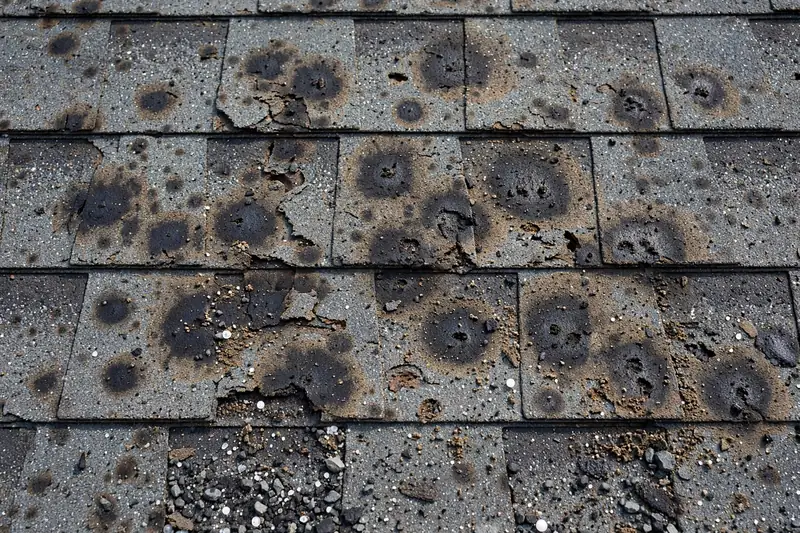
The direct answer: in Oklahoma, insurers pay for functional hail damage and increasingly exclude purely cosmetic damage — and the boundary is defined by whether the damage impairs the roof's function. Many Oklahoma policies now carry cosmetic-damage endorsements: dents that don't affect waterproofing or roof life may not be covered at all, even when they're clearly from hail.
The clearest plain-language definition comes from an Oklahoma courtroom. In Craig Combs v. CSAA General Insurance Co., a cosmetic-damage exclusion for metal roof hail damage was litigated, and the policy language defined cosmetic as damage that "only alters the physical appearance... but does not result in damage that allows the penetration of water... or failure... to perform its intended function." That's the test in one sentence: does it let water in, or stop the roof from doing its job? Hail bruising that fractures the shingle mat fails that test — it's functional. A shallow dent in a metal panel that sheds water exactly as before may not.
This is why documentation decides claims. A bruise that looks cosmetic from the ground can be a cracked mat underneath — granule loss, fractured fiberglass substrate, a shingle that will leak within a few storm cycles. The inspector's job is to photograph the failure at close range, tie it to a dated storm event, and state plainly what failed and why. An adjuster can dismiss a photo of a roof; it's much harder to dismiss a photo of a fractured mat with the storm date attached. If your policy carries a cosmetic-damage endorsement, ask your agent exactly how your carrier defines the line — then make sure your documentation lands on the functional side of it.
How Long Do You Have to File? The 24-Month Rule
The direct answer: under Oklahoma's HB 3495 (enacted May 2022), any policy that specifies a time limit for roof wind or hail damage must allow filing up to 24 months after the date of the loss — when the damage is not evident without inspection.
The longer legal context: the rule is quoted in the state's Unfair Claims Settlement Practices Act (Section 1219), and hail bruising that doesn't leak for months is exactly the "not evident without inspection" case.
Three caveats the law itself requires us to state: the rule applies only to policies that specify a time limit, and to policies signed after the law's effective date. And the Oklahoma Insurance Department's standing advice is to file as soon as possible after the storm — the 24-month window is a floor for hidden damage, not a recommendation to wait. Waiting degrades your evidence: granule patterns fade, subsequent storms muddy the timeline, and every month makes it harder to tie the damage to one date.
For Owasso, the date that matters is May 8, 2026 — the hailstorm that put up to 2.00" (hen-egg) hail within miles of town, with zip 74021 logging the most reports. The 24-month clock on that storm runs to May 2028. If you haven't had your roof inspected since, you're spending down the window. Our May 8, 2026 storm damage report documents exactly what the storm reports show, and our hail damage roof repair page explains how bruising hides until it leaks.
The Adjuster Process, Step by Step
Knowing the sequence removes the mystery — and the leverage gap. Here's how a roof claim typically moves, with the timelines Oklahoma guidance and current law attach to each stage.
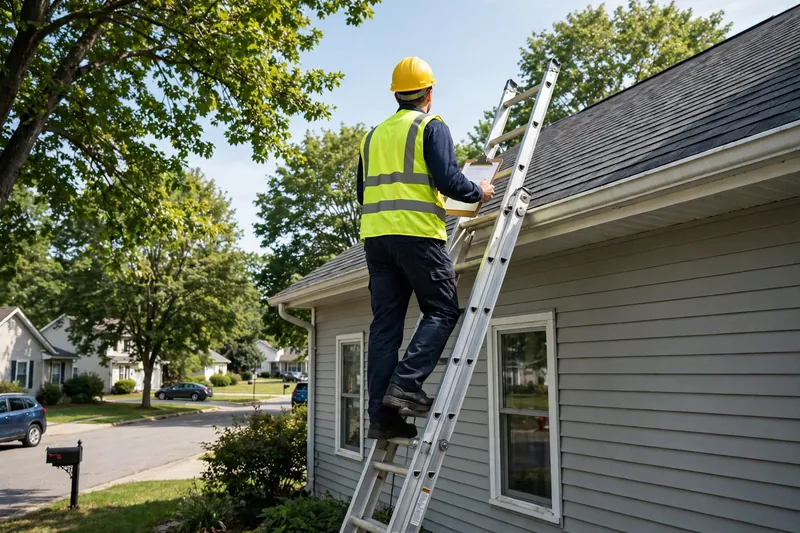
- Get an inspection before you file. A roofer's inspection with dated photos and a written damage assessment tells you whether you have a claim worth filing — and gives you evidence the adjuster can't unsee. Filing blind, with no documentation, puts the entire framing of the damage in the adjuster's hands.
- File the claim and get a claim number. Call your insurer or agent, describe the storm date and the damage, and record the claim number and the adjuster's name. Oklahoma Insurance Department guidance: carriers have about 30 days to acknowledge a claim.
- Meet the adjuster on the roof. Have your roofer or inspector present if possible. The adjuster photographs, measures, and decides what's covered — your documentation (storm date, close-up failure photos, inspection report) is your voice in that decision. Point out what you want examined; adjusters are thorough but they work fast.
- Receive the estimate and the decision. The insurer issues a scope and settlement figure. Per longstanding OID guidance, carriers have about 60 days from proof of loss to pay, deny, or continue investigating (up to 120 days if further investigation is needed) — most claims resolve within roughly 45 days. If the estimate is short, this is where your roofer's itemized scope becomes negotiating evidence.
- Understand the payout structure. On replacement-cost policies, you typically receive the ACV amount first, with the recoverable depreciation released after the work is completed and invoiced. Know which check is which before you sign a repair contract.
A note on 2026 legislation: Oklahoma lawmakers advanced HB 2933 in 2026, a proposed Homeowner Claims Bill of Rights whose text sets tighter timelines — claim acknowledgment within 14 days, accept/deny/investigation decisions within 30 days of executed proof of loss, the adjuster's detailed estimate shared within 7 days of preparation, and pay/deny/explain within 60 days (extending to 90 with further investigation, plus 20 more days in a Governor-declared catastrophe). As of our research, its enacted status was not confirmed, so treat those numbers as proposed — but they signal where Oklahoma consumer protections are heading. We'll update this page once the status is confirmed.
What to Do If Your Claim Is Denied
A denial is a decision, not a verdict — and it's often a documentation problem rather than a coverage problem. Work it in this order:
- Get the denial in writing, with the specific reason. "Cosmetic," "wear and tear," "below deductible," "pre-existing" — each has a different rebuttal, and you can't rebut a shrug. Ask for the adjuster's detailed estimate and the policy language cited.
- Re-document the damage. If the denial says "cosmetic" or "wear," a second inspection with closer photography — mat fractures, granule loss patterns, wind-creased tabs tied to the storm date — directly answers the objection. Functional damage proven with photos is the rebuttal to a cosmetic denial.
- Request re-inspection. You can ask the carrier to send the adjuster back out, ideally with your roofer present. New evidence is the basis; "I disagree" alone rarely moves it.
- Call the Oklahoma Insurance Department. The consumer hotline is 1-800-522-0071. OID regulates claim-handling practices — if timelines are being ignored or the process feels wrong, that's the regulator to talk to.
- Know when it's beyond a roofer. For coverage disputes that re-inspection doesn't resolve, talk to a licensed attorney — not a roofer, and not this page. We're roofers, not lawyers; legal disputes need legal counsel.
Can a New Roof Lower Your Premium? The Class 4 Discount
The direct answer: yes — several carriers writing in Oklahoma discount the wind/hail portion of your premium for a verified Class 4 impact-resistant roof. Mercury Insurance's 2026 Oklahoma product averages $420 per year (12.4%) for qualifying roofs; Tulsa-area roofers cite 15–30% off the wind/hail portion more broadly.
Two things to get right: the discount applies to the wind/hail portion of your premium, not the whole bill — and carriers typically require UL 2218 Class 4 verification, usually a Proof of Installation certificate, with the discount applying annually.
There's also an upgrade path worth knowing about: Mercury's product includes optional Hail Resistant Roof Upgrade Coverage, which lets a covered loss rebuild to Class 4 (IBHS-recognized) shingles — and the upgraded roof then qualifies for the ongoing discount. If you're replacing a storm-damaged roof anyway, ask your agent whether your carrier offers an equivalent upgrade option before you choose materials. Our storm damage roof repair in Owasso page covers the replacement decision in more depth.
How We Document Damage for Your Adjuster
This is the service behind the guide. When our repair crews inspect a storm-damaged roof, the report is built for two audiences — you and your adjuster:
- Dated, close-up photos of every failure point — bruised mats, fractured shingles, creased tabs, lifted ridge caps — not wide shots of a roof.
- The storm date on record — tying damage to a documented event (like May 8, 2026) is what turns "wear and tear" into a dated loss.
- A plain-language damage assessment stating what failed, why it's functional (not cosmetic) damage, and what the repair scope is.
- An itemized scope your adjuster's estimate can be compared against line by line — the negotiating document if the first offer is short.
We help you document. Your agent and your adjuster make the coverage call — and with this file in hand, they make it on your evidence, not just theirs.
Roof Insurance Claim FAQs
Under HB 3495 (2022), policies that specify a time limit must allow filing up to 24 months after the date of loss when the damage isn't evident without inspection — hail bruising that takes months to leak is the textbook case. But the Oklahoma Insurance Department advises filing as soon as possible after the storm; the 24-month window is a floor for hidden damage, not a reason to wait. For the May 8, 2026 Owasso hailstorm, that window runs to May 2028 — and every month you wait, your evidence gets weaker.
Functional damage breaks the roof's waterproofing or shortens its remaining life — fractured shingle mats, granule loss exposing asphalt, creased tabs. Cosmetic damage only alters appearance without impairing function — shallow dents that shed water exactly as before. Oklahoma insurers pay for functional damage; cosmetic damage is increasingly excluded by endorsement. An Oklahoma court case (Craig Combs v. CSAA) defined cosmetic as damage that "only alters the physical appearance... but does not result in damage that allows the penetration of water... or failure... to perform its intended function." Documentation — close-up photos tied to a storm date — is what puts your damage on the functional side of that line.
At minimum, your wind/hail deductible — commonly 1–5% of your home's insured value in Oklahoma, so $2,500–$12,500 on a $250,000 home. On replacement-cost policies you may also front the recoverable depreciation until work is complete. And if your roof is insured at actual cash value, depreciation comes out of the payout before you see it. Small repairs frequently land entirely below the deductible, meaning they're out-of-pocket even when the damage is a covered peril. Check your declarations page or ask your agent for your exact numbers before you file.
Per Oklahoma Insurance Department guidance, carriers have about 30 days to acknowledge a claim and about 60 days from proof of loss to pay, deny, or continue investigating (up to 120 days if further investigation is needed) — with most claims resolving within roughly 45 days. A proposed 2026 law (HB 2933, the Homeowner Claims Bill of Rights — enacted status unconfirmed at our last check) would tighten several of these timelines. Delays usually come from documentation gaps, so the fastest thing you can do is arrive with dated photos and an inspection report.
Yes — and it's the single highest-leverage step in the whole process. An inspection before filing tells you whether you have a claim worth filing, and gives you dated photos and a damage assessment the adjuster has to reckon with. Filing blind puts the entire framing of your damage in the adjuster's hands. Our inspections are free, the photos are yours to keep, and the report is written to be adjuster-ready — storm date, close-ups, and a clear functional-damage statement.
Several Oklahoma carriers discount the wind/hail portion of the premium for verified Class 4 roofs — Mercury's 2026 Oklahoma product averages $420/year (12.4%), and Tulsa-area roofers cite 15–30% off the wind/hail portion more broadly. You'll typically need UL 2218 Class 4 verification (a Proof of Installation certificate), and the discount applies annually. Note it's a portion of your premium, not the whole bill — and ask your agent what your specific carrier requires before you choose materials.
Get Your Damage Documented Before You File
The adjuster's decision runs on evidence. A free inspection gives you dated photos, a storm-tied damage assessment, and an itemized scope — the file that turns a claim into a covered claim. And remember: this guide is information, not legal advice. Check your policy, talk to your agent.
Free inspection · No-pressure · Photos of everything